Hydrogeological and Geophysical Survey The drilling process begins with a comprehensive hydrogeological investigation, supported by geophysical surveys. These studies identify suitable locations for drilling by mapping subsurface layers and detecting potential aquifers. In Basement Complex areas, the most productive water zones are often found in weathered and fractured bedrock, while Sedimentary Terrains typically offer porous sandstone aquifers.
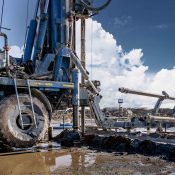
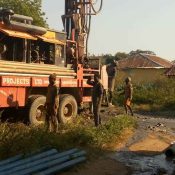
Mobilization of Drilling Equipment Depending on the terrain, we deploy either rotary drilling rigs (common in sedimentary formations) or down-the-hole (DTH) hammer rigs (used in crystalline rock environments). All required materials, including casings, gravel packs, and drilling fluids, are transported to the site.
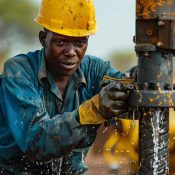
Drilling Through the Overburden Drilling begins with the penetration of the overburden—the unconsolidated layer of soil, clay, or sand that lies above the bedrock or aquifer zone.
Penetrating the Aquifer Zone Drilling continues until the borehole reaches a productive aquifer. In crystalline terrains, this typically involves identifying fractured or jointed zones within the bedrock. In sedimentary terrains, aquifers are usually found in sandy or gravelly layers.
Casing and Screen Installation Once the desired depth is reached, PVC or steel casing pipes are inserted to support the borehole walls. A screen—a perforated section of the casing—is positioned at the aquifer level to allow water to enter while preventing sand and debris from entering the system. In sandy aquifers, longer screens are often required. In fractured bedrock, screens are installed specifically across the water-bearing fractures.
Gravel Packing The screen section is surrounded by a gravel pack, consisting of clean, well-graded silica sand or gravel. This acts as a natural filter, enhancing water flow and reducing turbidity.
Borehole Development The borehole is cleaned using compressed air or water to remove drilling debris and fine particles. This process, known as development, enhances water inflow and ensures clarity.
Pumping Test (Yield Test) A controlled pumping test is conducted to evaluate the sustainable yield of the borehole. The data collected determines the appropriate pump size and helps estimate the long-term water supply capacity.
Water Quality Testing A water sample is sent to an accredited laboratory for full physio-chemical and microbiological analysis. Parameters such as pH, iron, manganese, hardness, E. coli, and total dissolved solids (TDS) are evaluated to confirm potability.
Pump Installation and Reticulation Following satisfactory testing, a submersible pump is installed, connected to the power supply, and integrated with an overhead tank system or direct water supply line.